
Supercommunicators is often listed among the best communication books for its practical advice and science-backed insights into how we connect with others. This blog is a book review of Supercommunicators: How to Unlock the Secret Language of Connection by Charles Duhigg. In this book, Duhigg explores what makes some people incredibly effective at communication, while others struggle to be heard or understood. If you’ve ever wanted to improve your conversations, strengthen your relationships, or navigate difficult discussions with more ease, this might be the book for you.
This post may contain affiliate links. Please see my full disclosure policy for details.
Introduction: Supercommunicators
I’ve been creating content on YouTube for over five years now, and I’ve seen a huge improvement in how I communicate my thoughts and ideas. That growth has only accelerated since launching my podcast, Not Another Money Podcast, in July 2024. It’s a space where I have real money conversations with financial experts and inspiring individuals doing great things in business and life—giving a platform to stories that might otherwise go unheard.
As someone always looking to grow personally and professionally, I’m constantly on the lookout for the best communication books that can help sharpen my message and deepen my connections.
As I work toward my mission of growing the UK’s largest female personal finance podcast, I know that refining my communication skills is essential. I want to have meaningful conversations with my guests, teach with clarity on my platform, and ultimately become a better all-round communicator.
While researching the best books on communication, Supercommunicators kept coming up as a top recommendation. So, of course, I ran to Audible, downloaded it, and listened to it on my next run.
I’ve always been curious about what makes certain conversations “click” while others feel awkward or forced—especially in high-stakes situations. Duhigg’s insights immediately drew me in. He combines neuroscience, psychology, and real-world examples to explain how we can all become better communicators.
If you’ve ever found yourself stuck in a frustrating conversation or struggling to connect with someone important in your life, this book offers practical tools and frameworks to help.
In this review, I’ll share a summary of the book, key lessons, and what I liked (and didn’t like) about it.

About the Author
Charles Duhigg is a Pulitzer Prize-winning journalist and the bestselling author of The Power of Habit and Smarter Faster Better. His work blends investigative journalism with deep dives into behavioural science, exploring how habits, productivity, and decision-making shape our lives. In Supercommunicators, Duhigg shifts his focus to the science of human connection. He unpacks why certain conversations succeed while others fall flat, using insights from neuroscience, psychology, and real-world case studies. Through this book, Duhigg shows readers how communication isn’t just about talking—it’s about recognising the type of conversation you’re in and responding with intention and empathy.
There are countless books on communication out there, but what makes Supercommunicators stand out is its balance of science, storytelling, and practical application. It doesn’t just teach you how to speak or listen better—it helps you understand what kind of conversation you’re actually having. That depth and nuance is what puts it high on my list of the best communication books for anyone serious about improving how they connect with others.
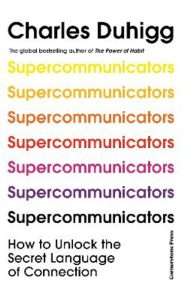
Book Summary – Supercommunicators
In Supercommunicators, Duhigg breaks down the concept of communication into three core types of conversations: practical (solving problems), emotional (expressing feelings), and social (figuring out how we relate to each other). One of the biggest communication breakdowns happens when two people are having different types of conversations without realising it.
Supercommunicators are people who can quickly identify what kind of conversation they’re in—and then adapt their approach accordingly. Duhigg argues that anyone can learn this skill with the right awareness and practice.
The book also introduces several key tools, like “looping for understanding,” where you paraphrase what the other person says to confirm you’re truly hearing them. Duhigg backs up his strategies with fascinating stories—from hostage negotiations to marriage counseling—that show how powerful great communication can be.
If you want to give it a listen, you can get started with a free audiobook from Audible here.

Things I Liked About Supercommunicators
This book gave me a lot to think about, especially in how I approach conversations with podcast guests, colleagues, friends and family. These were some of the standout lessons that really stuck with me:
The three types of conversations framework was a total game-changer. Duhigg explains that most conversations fall into one of three categories: practical (focused on solving problems), emotional (focused on feelings), or social (focused on relationships and identity). Miscommunication often happens when two people are having different kinds of conversations without realising it—for example, one person is trying to offer solutions while the other just wants to be heard. Learning to recognise which type of conversation I’m in has made my interactions much smoother and more meaningful, especially in emotionally charged or high-stakes situations.
Looping for understanding is a technique Duhigg highlights that’s simple but incredibly effective. The idea is to paraphrase what the other person just said, then check in to see if you got it right. It shows you’re actively listening, makes the other person feel heard, and helps avoid assumptions or misinterpretations. I’ve started using this more intentionally in my podcast interviews, and it’s made my guests feel more connected and valued, which makes for much richer conversations.
The storytelling in the book is top-tier. Duhigg doesn’t just throw theories at you—he brings the ideas to life through real-world examples like marriage counselling sessions, FBI hostage negotiations, corporate boardroom conflicts, and even personal anecdotes. These stories made the concepts not only memorable but also relatable. I could see myself and my own communication habits in so many of the examples, which helped me apply the lessons more effectively.
The advice is incredibly practical and easy to apply. One of the things I appreciated most is that you don’t need to be a communication expert or read the book cover to cover to start seeing results. Whether you’re navigating a tough conversation with a friend, trying to better manage a work meeting, or having an emotional heart-to-heart with a loved one, the tools Duhigg shares can help you connect more deeply and avoid common communication pitfalls.
These kinds of applicable tools and insights are what make Supercommunicators more than just a good read—it’s a resource I’ll keep coming back to, and one I’d definitely include in a roundup of the best communication books for professionals, creators, and everyday life.

Things I Didn’t Like About Supercommunicators
While I found Supercommunicators insightful and full of value, there were a few minor drawbacks that stood out to me—though they didn’t take away from the overall usefulness of the book.
Some of the stories felt a bit too long or overly detailed. Don’t get me wrong—I loved the real-life examples, and they were helpful in illustrating the concepts. But in a few places, the storytelling seemed to drag or go off on tangents that didn’t always tie back clearly to the core lesson. I found myself occasionally drifting or wishing the point had been made a little more concisely so the momentum of the book could continue.
The book leans more toward building awareness than providing a structured, step-by-step system. If you’re looking for a clear communication formula or a checklist-style approach to mastering conversations, this might not be the book for you. Duhigg focuses more on helping readers understand how communication works and why it breaks down, which is incredibly useful—but it also means you’ll need to do a bit of the work yourself in applying the concepts to your own life.
Rating
Overall, I’d give Supercommunicators a 4 out of 5. It’s an engaging, well-researched book that offers fresh insight into how we talk—and how we can get better at it. While it doesn’t offer a strict formula, its strength lies in the clarity and simplicity of its ideas.
Final Thoughts
Supercommunicators is arguably one of the best books on the art of communication. It is a valuable read for anyone who wants to connect more deeply with others. Whether you’re trying to be a better leader, friend, partner, or parent, this book will help you show up more effectively in every conversation. I definitely recommend it to anyone interested in the art and science of communication.
BUY THIS BOOK TODAY ON AMAZON
Check out these other related books
If you’ve read this book, or are interested in similar topics, here are a few additional books to check out that you may find interesting. Some I’ve read myself, and others come highly recommended by others in this space:
- The 7 Habits of Highly Effective People by Stephen Covey. This classic self-help book provides practical advice for building a successful and fulfilling career. It includes tips for setting goals, prioritising tasks, and developing a positive attitude.
- The 21 Irrefutable Laws of Leadership by John C. Maxwell. This book focuses on developing the leadership skills necessary for success in the business world. It also provides practical advice for building a successful career.
- The Lean Startup by Eric Ries. Ries provides a new approach to building a successful business by focusing on developing a minimal viable product. Then testing it with customers, and using their feedback to iterate and improve.
- Drive: The Surprising Truth About What Motivates Us by Daniel H. Pink. This book explores the science of motivation. It provides practical advice for using intrinsic motivation to achieve success in personal and professional life.
- The Personal MBA: Master the Art of Business by Josh Kaufman. Kaufman provides a comprehensive overview of the most important concepts in business. He gives readers the knowledge they need to build a successful career in any field.
- The 4-Hour Work Week by Timothy Ferriss. This book provides a guide to escaping the 9-to-5 grind. It outlines how to build a business that allows you to live the life you want. All while earning money on your own terms.
More Like This:
Did you enjoy this post ‘Book Review: Supercommunicators: How to Unlock the Secret Language of Connection’. Then you will also enjoy my other book reviews below:
Book Review: The Total Money Makeover By Dave Ramsey





Dear Tolufrimpong,
I hope this message finds you well. I am reaching out to inquire about your company’s current capacity availability, as we have an upcoming project slated to commence in the second half of the year. We would appreciate it if you could provide a quotation for your services to help us proceed with planning.
Looking forward to your feedback.
Best regards,
George Silver
Purchasing Manager
Nexans
We are currently seeking companies like yours for a potential long-term partnership. Could you kindly share your product offerings along with pricing details? Please contact me on WhatsApp: +44 730 757 2547