Not all overspending is obvious. This post explores the quiet money leaks that slowly drain our finances and how noticing them can change how money feels day to day.
This post may contain affiliate links. Please see my full disclosure policy for details.
Quiet Money Leaks You May Have Missed And Why Small Costs Hurt More Than We Think
We often associate “money problems” with big moments like a missed rent payment, a huge purchase, or a shock bill.
But for most of us, the thing that keeps our money feeling tight isn’t dramatic.
It’s quiet.
Invisible charges.
Free trials that roll on forever.
Subscriptions we signed up for during a different season of life.
If you asked how much these small costs add up to each year, most people would guess far less than it actually is. And yet, when you stop and tally them, the total often surprises you.
This isn’t because we’re careless or irresponsible. It’s because modern spending is designed to be easy. And when money leaves your account with zero friction, your brain barely notices it, until you look at your balance and think, I should have more than this. That feeling is so real and relatable. And it’s telling you something really important that you need to pay attention to.
Why quiet money leaks hurt more than big spending
The reality is that with big expenses, you usually feel the decision that you made. You often remember it. You can certainly trace it.
However, with those quiet money leaksm they behave differently:
- There’s no moment of choice each month
- There’s no reminder when money leaves
- They blend into your regular routine
- You forget you even signed up in the first place
So the real impact is more than just financial, it’s psychological.
You feel like you’re trying to be good with money, but somehow you can never get ahead. That can be incredibly frustrating
But it’s not a personal failure, it’s actually a design problem.
Where these leaks come from
Most quiet money leaks don’t look like reckless spending, they look more like convenience.
- A streaming service you meant to evaluate
- A learning app you wanted to try
- A gym membership paused but not cancelled
- A kids’ subscription you forgot was renewing
- Software you downloaded for a project you never finished
- A “free trial” you forgot to cancel
These all made sense at the time and none of them felt wasteful in isolation. But together? They siphon more cash than we usually expect.
And because they don’t feel dramatic, most people don’t notice until they deliberately look. Which is why doing a subscription audit becomes a clarity exercise, not a punishment.
A different way to think about money checks
If money feels tight, the instinct might be to tighten even more. and to cut out joy, freeze spending, or make yourself small in how you live.
But what if the challenge isn’t doing less, but seeing clearly?
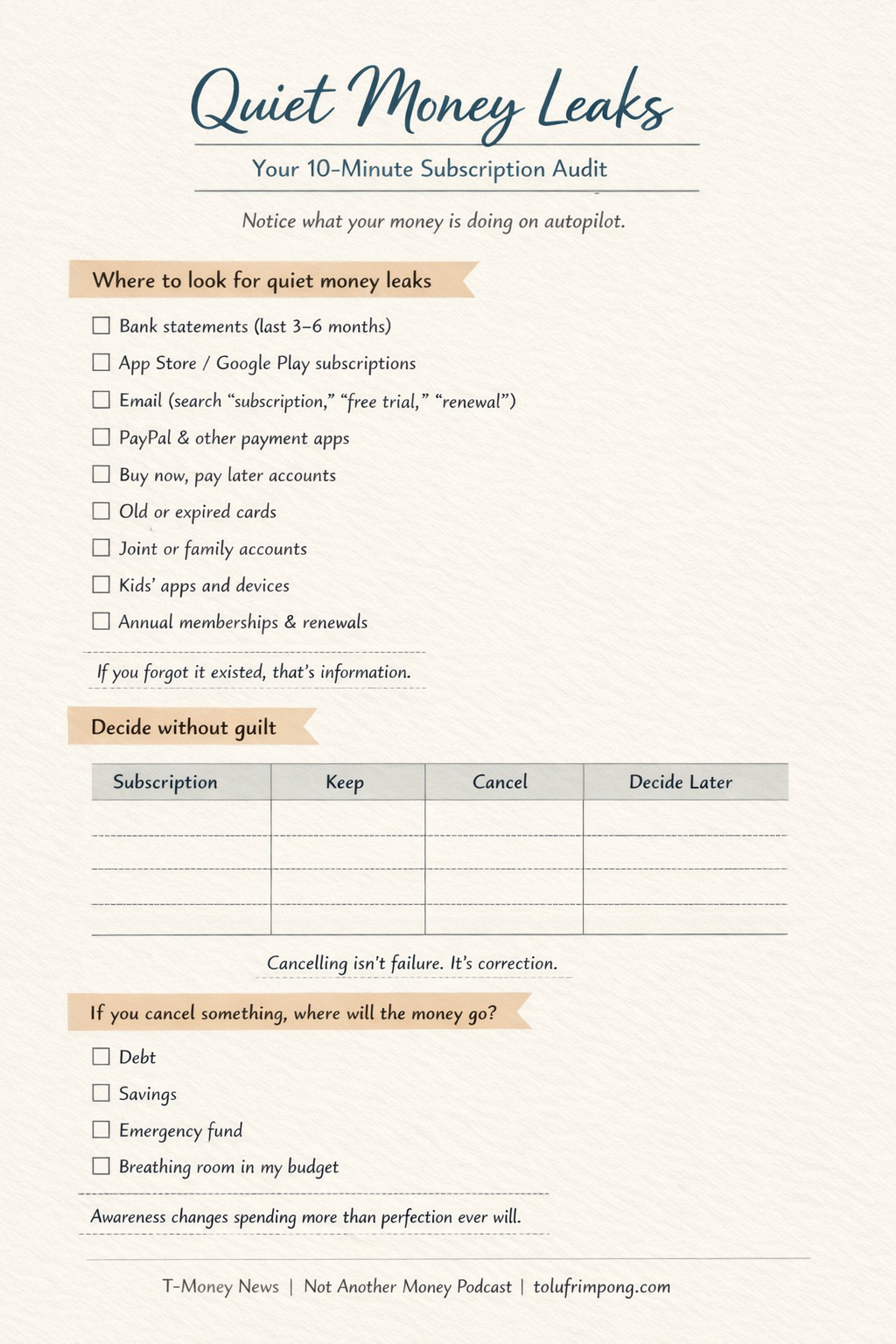
This is one of the reasons I created the Quiet Money Leaks Checklist a printable, one-page tool you can use (in 10 minutes) to spot the recurring costs you might’ve stopped noticing. It’s not exhaustive. It’s not about cutting every subscription. It’s about becoming aware of what your money is actually doing.
You can grab that checklist here, and if you love planning or organising your money visually, it pairs beautifully with my Zero-Based Budget Template, where you can give every pound a job and see where it’s going each month.
Small leaks can slow real progress
We talk a lot about budgeting, saving, and reaching big financial goals, and those things are important, but small leaks have a way of sloquietly slowing down our progress.
Imagine this:
Instead of losing £61 a year on forgotten subscriptions, what if you redirected that same money into something that actually serves your goals?
Maybe it goes into a sinking fund for a family holiday.
Maybe it buffers your emergency savings.
Maybe it helps pay down debt.
Maybe it buys you more breathing room in your budget.
Those decisions compound over time, not just in pounds, but in peace of mind.

Why your money feels like it’s always a step behind
It’s not that you’re doing money wrong. It’s just that money decisions have become autopilot decisions, not conscious ones.
When we stop noticing where money is going, we stop controlling it. And that’s why a quick audit is so powerful. It brings attention to something you were overlooking.
Once the leaks are visible, they feel easier to address. And once you start addressing them, your money starts feeling more like yours again.
Clarity builds confidence
Stepping back and looking at your finances with curiosity and not shame, is one of the most generous things you can do for yourself.
It’s not about being perfect or cutting everything you love out.
It’s about noticing:
What’s still earning its place?
What feels outdated or unused?
What quietly drains you without you noticing?
Those aren’t questions of judgement, raather I see these questions as questions of alignment.
And when your money is aligned with your life and not exitng your account on not autopilot, you feel more in control, more confident, and more like you’re steering your financial story, not reacting to it.
If you want guidance beyond this post, the latest podcast episode walks through this topic from a different angle, practical questions, mindset reframes, and a calm way to think about cancelling without guilt.
You can listen to that here.
And if you love visual tools or printable worksheets, don’t forget the Quiet Money Leaks Checklist and the Zero-Based Budget Template, both built to help you see your money clearly without overwhelm.
Related reading
To keep the momentum going, if you enjoyed this post, ‘Quiet Money Leaks You May Have Missed And Why Small Costs Hurt More Than We Think’, then you will also enjoy my other blog posts on similar topics, check them out below:
Slash Subscription Costs These 10 Smart Ways
How To Stick To A Budget — 15 Simple Ways
Find The Best Cashback Sites In The UK
These posts all complement the ideas here and give you more ways to look at spending with intention.